What the Museum of the Future Involves
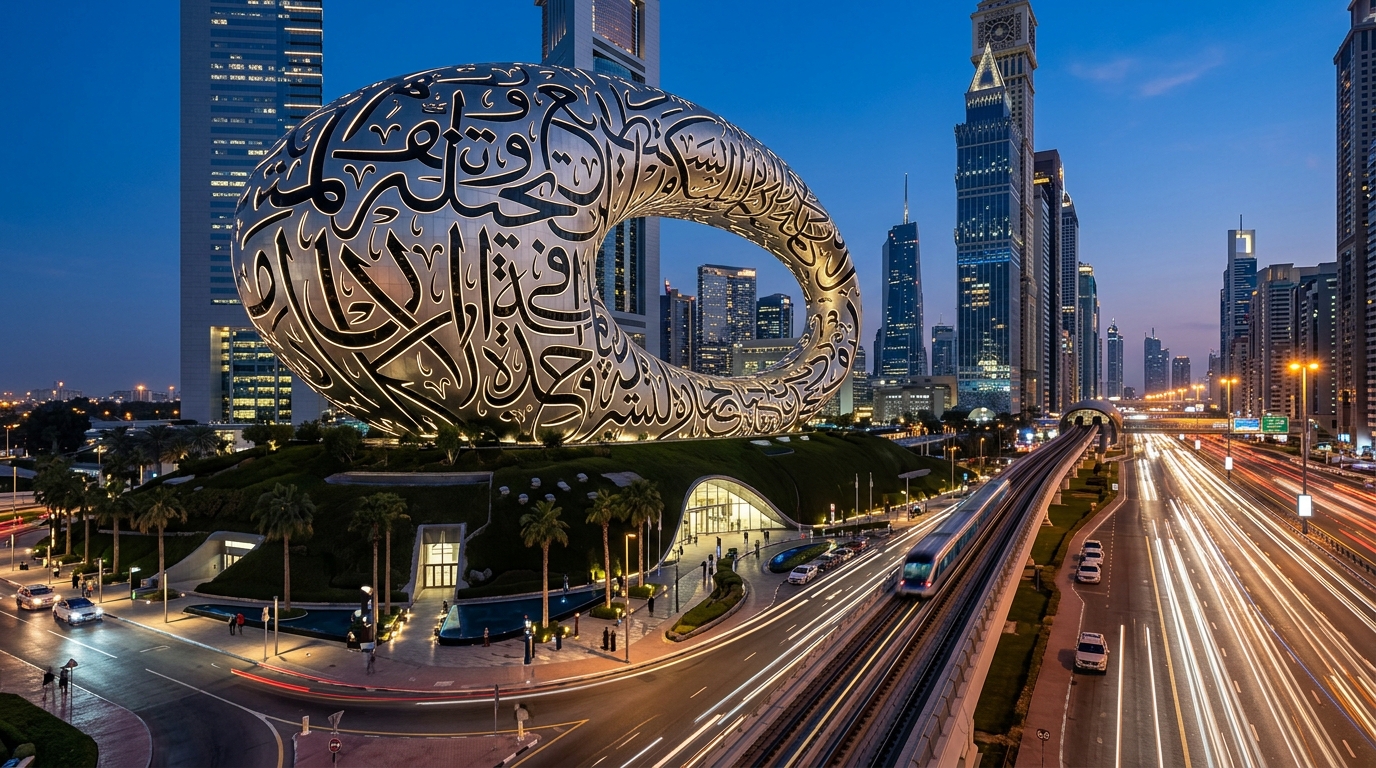
Standing 77 meters tall along Sheikh Zayed Road, the Museum of the Future is an architectural marvel designed by Killa Design and engineered by Buro Happold, featuring an oblong torus structure completely devoid of internal load-bearing columns.
Described as 'the most beautiful building on Earth', the structure serves as an active incubator for global visionary ideas. Rather than showcasing static historical artifacts behind glass cases, the museum positions visitors as active space explorers, bio-engineers, and wellness practitioners embarking on an immersive multi-sensory journey 50 years into the future.
Architecture, 1,024 Facade Panels & Calligraphy Meaning
The museum's physical geometry embodies deep philosophical symbolism:
- The Green Mound: Represents the earth, permanence, and rooted historical heritage.
- The Torus Structure: Represents humanity's collective strength, innovation, and artistic mastery.
- The Central Void: Represents the unwritten, unknown future that humanity has yet to imagine.
The seamless exterior facade comprises exactly 1,024 precision-manufactured stainless-steel panels (representing a kilobyte of digital data), etched with Arabic calligraphy quotes authored by His Highness Sheikh Mohammed bin Rashid Al Maktoum, illuminated each night by 14,000 meters of programmable LED lighting.
Rendered by prominent Emirati artist Mattar bin Lahej, the poetic verses include: 'The future belongs to those who can imagine it, design it, and execute it. It isn't something you await, but rather create.'
The Five Narrative Chapters Set in 2071
Visitors journey through five immersive narrative chapters set in the year 2071: beginning aboard the simulated OSS Hope orbital space station, exploring the Heal Institute's digital DNA vault of 2,400 species, unwinding in the sensory sanctuary of Al Waha, testing prototypes in Tomorrow Today, and empowering youth in Future Heroes.
1. Chapter 1: Orbital Space Station Hope (Level 5)
Guests board a simulated Falcon space shuttle ascending 600 kilometers above Earth to dock with OSS Hope, an orbital energy station supplying solar power back to the planet.
2. Chapter 2: The Heal Institute (Level 4)
A digital ecology lab addressing climate change. The centerpiece is the 'Vault of Life'—a mesmerizing optical library containing 2,400 glass cylinders displaying digital genetic codes of endangered plant and animal species.
3. Chapter 3: Al Waha Wellness Sanctuary (Level 3)
A digital-detox retreat designed to stimulate human senses through meditative light waves, acoustic harmonic frequencies, and therapeutic vapor treatments.
4. Chapter 4: Tomorrow Today (Level 2)
An ever-evolving technology exhibition showcasing operational prototypes in electric aviation, bionic robotics, vertical farming, and clean energy created in partnership with international research institutes.
5. Chapter 5: Future Heroes (Level 1)
A dedicated discovery floor designed for children under 10, utilizing game-based interactive challenges to develop problem-solving, collaboration, and critical-thinking skills.
The Cantilevered Viewing Deck Within the Torus Void
One of the museum's most unforgettable architectural perspectives is found on Level 2:
Guests can step outside onto the dramatic cantilevered open-air viewing deck positioned directly within the central void of the torus, offering unprecedented panoramic views of Sheikh Zayed Road's futuristic skyline from inside the heart of the building.
Standing inside the void, you look upward at the smooth, curving inner walls of the torus framed against the sky, feeling the breeze and viewing the city's supertall towers framed through the elliptical cutout.
Ticketing Guidelines & Advance Booking Protocol
Because of international acclaim and strict capacity controls, securing tickets requires foresight:
Admission is managed strictly via timed-entry tickets that must be reserved online weeks in advance during high-demand travel seasons, as same-day walk-in tickets are virtually never available at the entrance kiosk.
Each ticket assigns a specific 30-minute entry window. Arriving on time is essential, as late arrivals may be denied entry during sold-out operating days. Children under 3 years old and People of Determination with one companion enter free of charge, though complimentary tickets must still be booked online.
Transit & Direct Metro Link Bridge
Reaching the museum is effortless through Dubai's public transit network:
The museum connects seamlessly to the Dubai Metro Red Line via a dedicated, 212-meter air-conditioned elevated pedestrian link bridge leading directly from Emirates Towers Metro Station.
For drivers and taxi passengers, the venue provides valet parking services and underground parking with electric vehicle charging stations, although public metro transit remains the fastest method to avoid Sheikh Zayed Road peak traffic.
Photography Rules & Optimal Visiting Hours
Maximize your museum experience with these practical insider tips:
- Photography Guidelines: Non-commercial photography and mobile phone videography are fully permitted throughout all exhibitions. Professional tripods, selfie sticks, and lighting gear are strictly prohibited inside the galleries.
- Optimal Lighting Window: Morning slots (10:00 AM to 12:00 PM) offer natural sunlight pouring through the calligraphy windows, casting beautiful shadow script across interior white floors.
- Evening Facade Viewing: Even if visiting earlier in the day, return at twilight to view the exterior facade when the 14,000 meters of LED calligraphy lines illuminate against the night sky.