What is Off-Road Dune Bashing in Dubai?
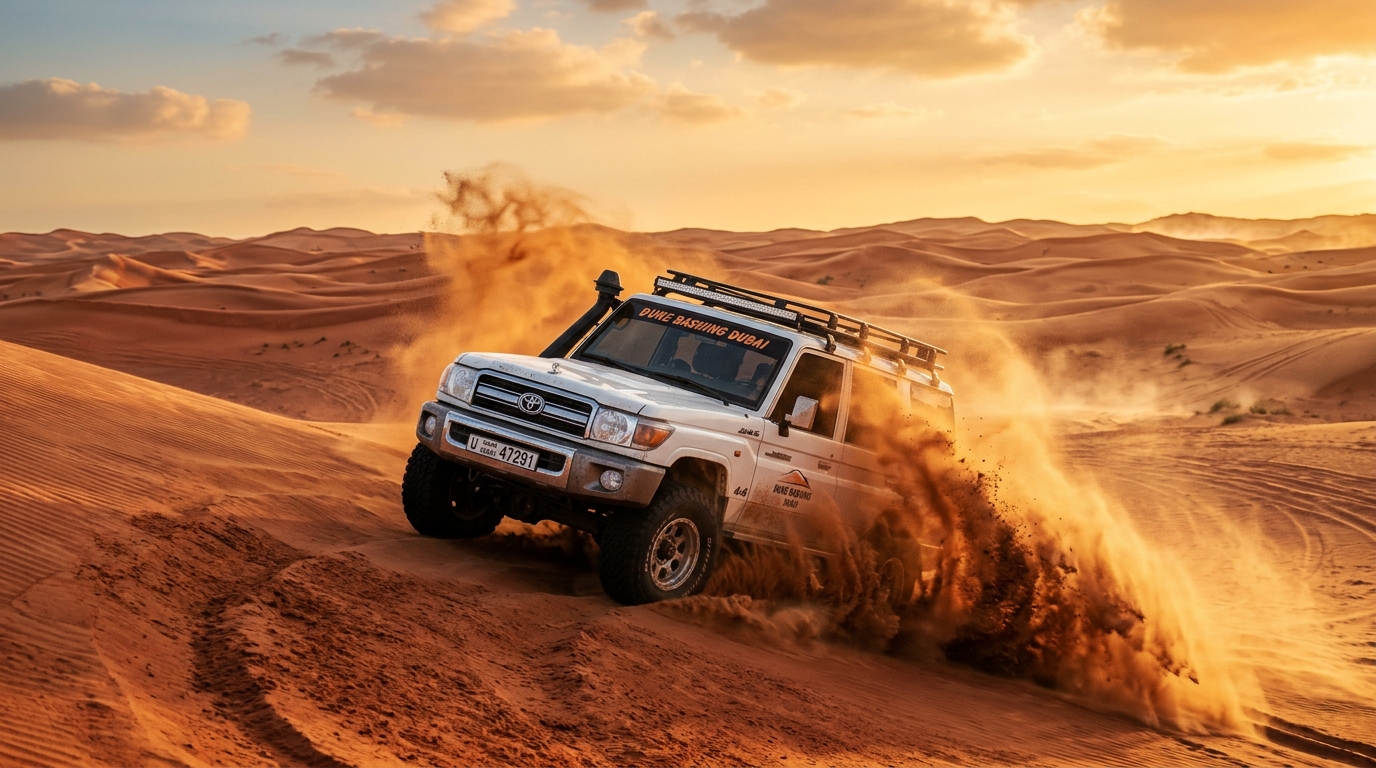
Off-road desert driving, widely known as dune bashing, is the signature adventure activity of the Arabian desert. Unlike standard highway driving, dune bashing involves four-wheel-drive vehicles traversing shifting, wind-sculpted sand dunes that vary in slope gradient, sand density, and crest shape. Passengers experience exhilarating movements across natural terrain, as experienced drivers ascend steep dune faces, balance momentarily along razor ridges, and descend sloping slip faces in controlled parabolic drifts.
The discipline evolved from traditional vehicular navigation into a structured commercial tourism activity. Before paved highways connected the emirates, travelling across the desert required specialized sand-driving competence. Today, commercial desert safaris in Dubai blend expedition traditions with strict vehicle safety inspections and professional driver licensing overseen by the Dubai Roads and Transport Authority (RTA) and the Department of Economy and Tourism (DET).
How the Experience Works: From City Pickup to the Sand Dunes
A typical afternoon dune-bashing excursion begins with hotel pickup in a climate-controlled 4x4 SUV. The drive takes approximately 45 to 50 minutes along the Dubai-Hatta Road (E44) toward the Lahbab desert basin. Modern urban high-rises give way to open gravel plains and then into rich terracotta sand, marking arrival at the desert staging boundary.
At the staging area, vehicles make an operational pause of approximately 15 minutes. During this stop, drivers manually deflate the tire pressure from standard highway levels (roughly 32 to 35 PSI) down to approximately 12 to 15 PSI. This deflation is a fundamental off-road driving technique rather than a statutory decree: reducing air pressure broadens the rubber contact patch, allowing tires to float over loose sand grains rather than digging ruts. Guests can use restroom facilities or observe mechanical preparations during this interval.
Once tire pressures are calibrated, vehicles enter the dunes, typically travelling in convoys of two or more 4x4s. Convoy travel is an established operator safety protocol that provides mutual assistance should a vehicle require sand recovery. The active driving session lasts approximately 35 to 45 minutes, culminating at an elevated summit dune for a 20-minute sunset photography stop before proceeding to a desert camp or returning to the city.
Regulatory Standards: Distinguishing Laws, Operator Policies, and Common Practices
To understand safety in the desert, travellers should distinguish between UAE legal statutes, tour operator fleet policies, and mechanical off-road driving practices:
Legal Statutes: Under UAE Federal Traffic Law (Article 15), every passenger must wear an individual seatbelt at all times while the vehicle is in motion. Furthermore, commercial desert safari vehicles must undergo annual technical safety inspections and hold active commercial registration under RTA fleet licensing guidelines. Drivers are legally prohibited from operating commercial passenger excursions on sand without an official RTA Desert Safari Driver Permit, which requires corporate sponsorship, security clearances, medical fitness tests, and specialized off-road certification at an accredited Dubai driving institute (such as Belhasa Advanced Motorist or Emirates Driving Institute).
Operator Fleet Policies: To safeguard passengers during high-energy off-road driving, reputable commercial operators fit vehicles with internal steel roll cages or reinforced roll bars designed to preserve cabin structural integrity in the event of an incline rollover. Tour operators also equip vehicles with first-aid medical kits, heavy-duty snatch straps, off-road recovery jacks, and GPS/radio communication equipment.
Common Off-Road Practices: Deflating tires to 12–15 PSI is an operational physics-based technique practiced by off-road marshals worldwide to improve traction on sand. Similarly, operating in convoys of two to three 4x4s and budgeting 35 to 45 minutes of driving time are standard industry operational practices designed to manage vehicle cooling, passenger comfort, and mutual recovery support.
Desert Geography: Lahbab Red Dunes vs. Dubai Desert Conservation Reserve (DDCR)
Understanding Dubai's desert geography is essential when planning your excursion, as different zones serve distinctly different recreational and environmental purposes.
The Lahbab Desert, situated near the Sharjah border around Al Badayer (often referred to as Big Red), is the primary hub for dynamic adventure tourism. The sand features a vivid terracotta hue caused by natural iron oxide coatings on quartz grains. Lahbab contains prominent dunes with steep slip faces reaching 30 to 40 meters, providing the topography needed for high-energy 4x4 driving, sandboarding, and sunset landscape photography.
In contrast, the Dubai Desert Conservation Reserve (DDCR) is an ecologically protected national park comprising 225 square kilometers. Under DDCR conservation regulations, independent off-road driving and high-intensity recreational dune bashing are strictly prohibited to protect fragile native vegetation and wildlife, including the free-roaming Arabian Oryx and desert gazelles. Excursions within the DDCR are restricted to permitted commercial operators conducting low-impact wildlife nature drives along designated desert tracks.
Dune Bashing vs. Quad Biking vs. Self-Drive Dune Buggies
Visitors frequently compare dune bashing with other desert adventure activities. Key mechanical and operational distinctions include:
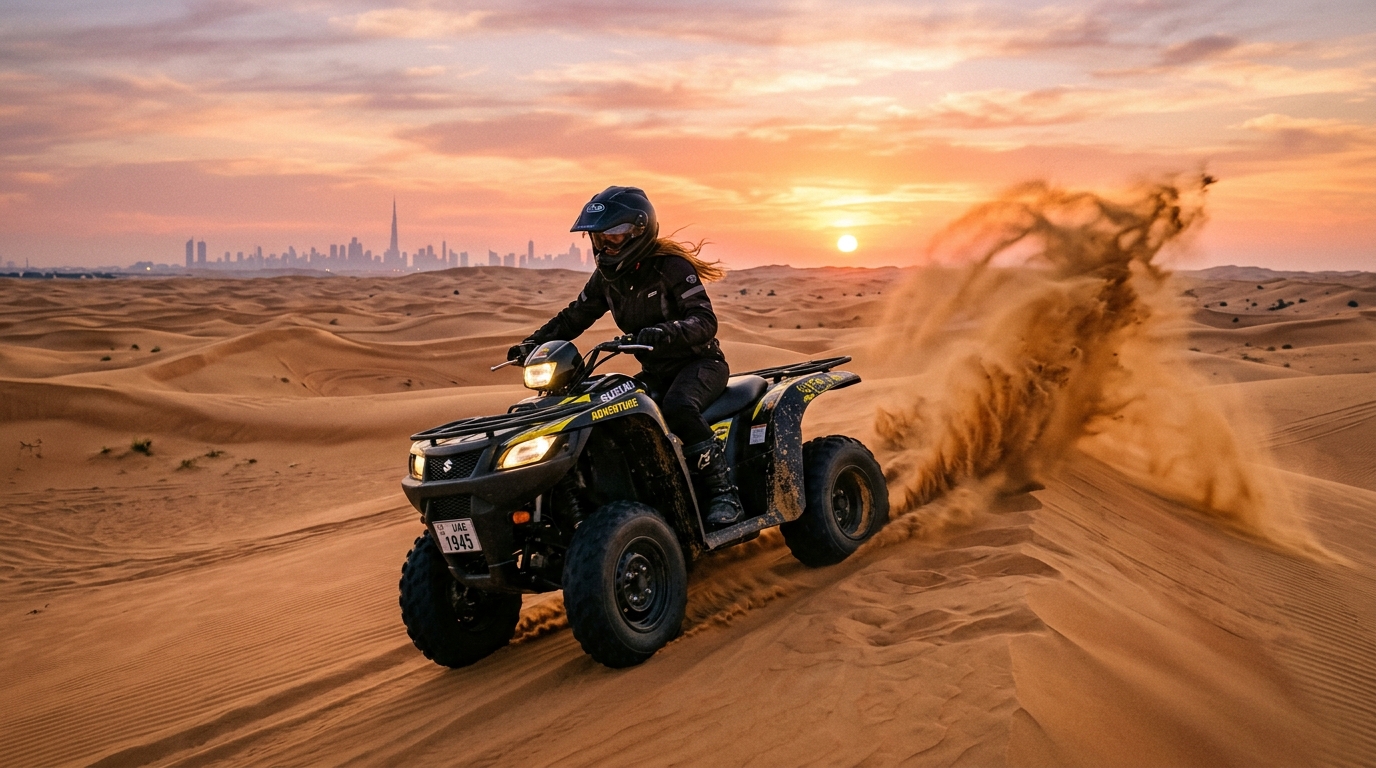
| Feature | Dune Bashing (4x4) | Quad Biking (ATV) | Dune Buggy (UTV) |
|---|
| Driver | Licensed professional safari marshal | You (self-driven) | You (self-driven) |
| Vehicle Format | Enclosed, air-conditioned 4WD SUV | Open-saddle handlebar quad bike | Tubular cage buggy with bucket seats |
| Steering Controls | Professional controls wheel/pedals | Handlebars with thumb throttle | Automotive steering wheel and pedals |
| Passenger Capacity | 4 to 6 passengers per vehicle | Single rider (or 2-seater quad) | 2-seater or 4-seater side-by-side |
| Physical Effort | Passive holding on | High (active body weight shifting) | Moderate (harnessed in bucket seat) |
| Protective Structure | Roll cage, 3-point seatbelts | Helmet and protective goggles | Multi-point harness and roll cage |
| Primary Location | Deep red dunes (e.g., Lahbab) | Designated tracks or guided trails | Guided open desert tracks behind lead guide |
Standalone Dune Bashing vs. Full Evening Desert Safari Package
TravelSaga offers two excursion formats to match different travel schedules and preferences:
Standalone Dune Bashing: Designed for travellers seeking off-road thrills without an extended camp commitment. You are transferred by private 4x4 directly to Lahbab for a 45-minute dune drive and sunset photo stop, returning to your hotel within approximately 3.5 to 4 hours.
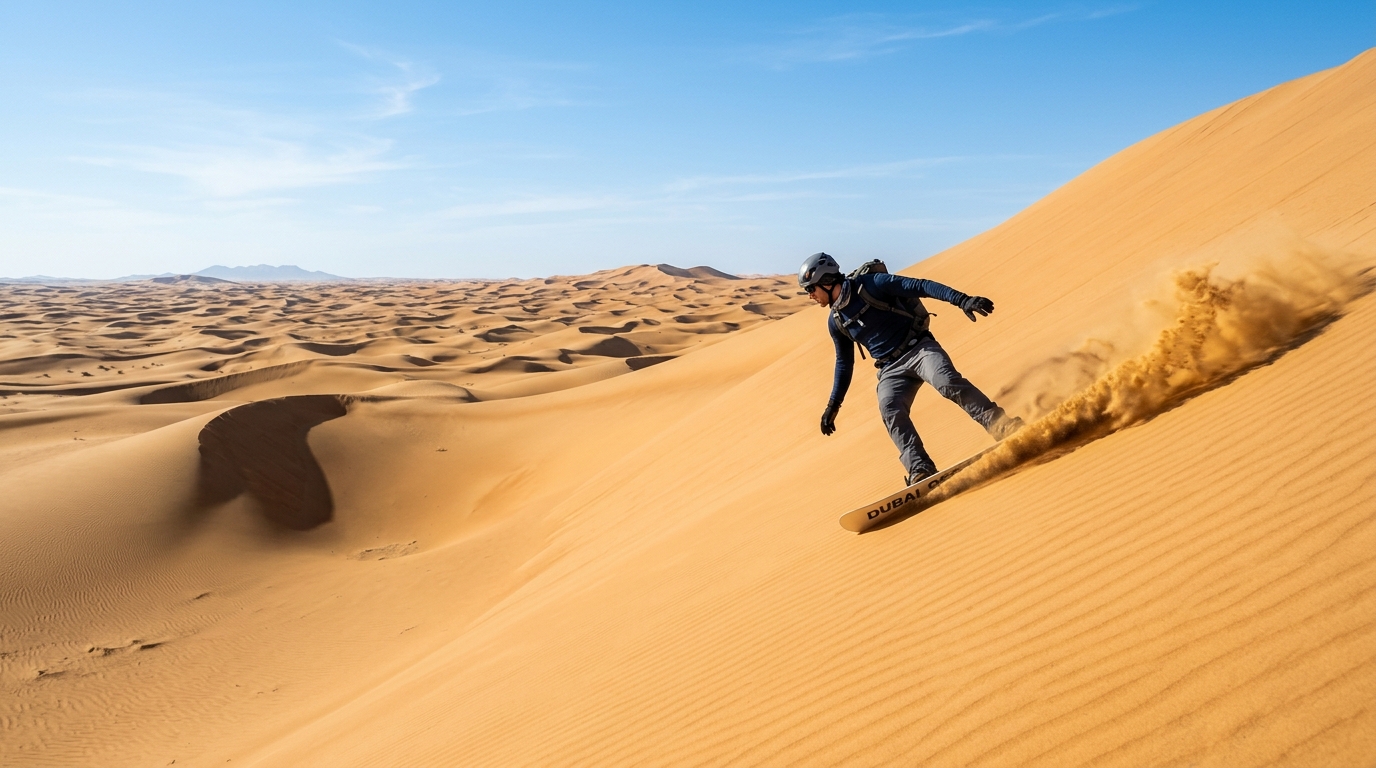
Full Evening Desert Safari Package: A comprehensive 6-hour excursion. Following the 4x4 dune drive, guests transfer to an authentic desert camp. The package includes a short camel ride, sandboarding down gentle slopes, henna hand painting, traditional Arabic coffee with dates, an open-air barbecue dinner, and cultural stage entertainment including Tanoura spinning and fire shows.
Best Time to Experience Dune Bashing in Dubai
Seasonality: The preferred season runs from October through April. During these cooler months, daytime temperatures generally range between 22C and 30C, making outdoor activities comfortable. Evenings in December and January can be cool, warranting light outerwear.
Summer Operations: From May through September, daytime temperatures frequently exceed 40C. During this season, morning desert safaris departing around 5:30 AM allow guests to experience dune driving before peak daytime heat sets in.
Daily Timing: For afternoon safaris, pickup between 2:30 PM and 3:30 PM allows the driving portion to coincide with late afternoon light, creating dramatic shadows across the dune ridges for photography.
Suitability, Age Guidelines, and Health Exclusions
Due to the sharp inclines, momentum, and body motion involved in 4x4 off-roading, tour operators enforce clear health exclusions aligned with tourism safety advisories:
Health Exclusions: Dune bashing is not suitable for pregnant women in any trimester, travellers with chronic back, neck, or spine injuries, individuals with serious cardiovascular conditions, or those recovering from recent surgery.
Age Guidelines: In alignment with UAE child passenger safety standards, infants under 3 years are not permitted on active dune-bashing drives because standard child car seats cannot safely accommodate severe off-road tilting. For families traveling with toddlers or seniors, operators provide direct, gentle transfers along flat graded desert tracks to the sunset point and camp.
Motion Sickness Advice: The physical sensations of dune bashing resemble a boat ride over rolling ocean swells. Guests susceptible to motion sickness should avoid heavy meals for 2 to 3 hours prior to departure and consider mild over-the-counter motion remedies taken 30 minutes before entering the dunes.
What to Wear and What to Bring
Clothing: Loose, breathable cotton or linen clothing is recommended. Long pants or knee-length shorts are practical when climbing in and out of 4x4s. During winter months (December to February), bring a light jacket or wrap for the evening camp.
Footwear: Closed sneakers or strapped sport sandals are practical for walking on sand. Flip-flops or open slip-on shoes can easily get buried in deep sand.
Sun Protection: Polarized sunglasses, broad-spectrum sunscreen, and a lightweight scarf or hat provide protection from glare and blowing sand. Keep mobile devices and camera equipment inside zipped pockets or bags when not in use to avoid sand ingress.
Booking Considerations and TravelSaga Concierge Support
Shared vs. Private Vehicles: Standard tours seat up to 6 guests in a shared vehicle. Booking a private 4x4 offers exclusive vehicle use and allows your group to request a gentler or more spirited driving style directly from your driver.
Advance Reservations: During high-season travel periods (November through March and public holiday weekends), desert safari slots fill quickly. Reserving 3 to 5 days in advance ensures vehicle availability and preferred departure timing.